
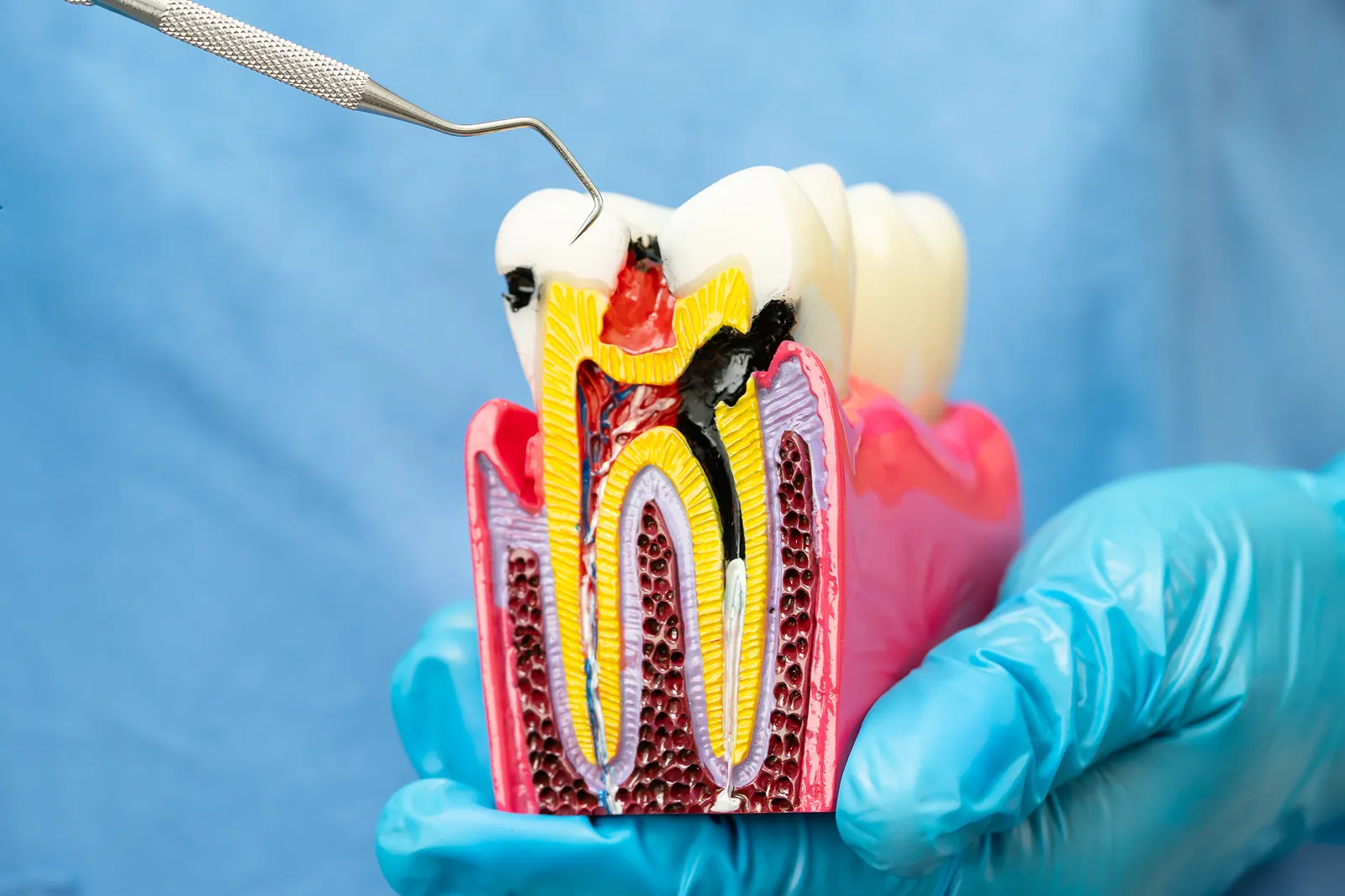
If a damaged or infected tooth can be treated and then protected with a crown, a root canal usually lets you keep it. If the tooth is too broken, or the gum and bone around it no longer hold it well, extraction may be the better choice. How much the tooth hurts doesn’t settle the question; an exam and X-rays do.
For patients in Bridgewater, Somerville and nearby towns, here is what that exam looks at, how the two options compare and what to ask before you decide.
Root canal or extraction: how do they compare?
| Root canal | Extraction | |
|---|---|---|
| What it does | Treats the inside of the tooth | Removes the tooth |
| What you keep | Your natural tooth | The space where the tooth was |
| Usual next step | A crown to protect the tooth | Deciding whether to replace the tooth (implant, bridge or removable option) |
| A good question to ask | Is there enough healthy tooth left to restore it? | How will the gap affect my bite if I don’t replace it? |
What does a root canal actually do?
The soft tissue inside a tooth, called the pulp, can become inflamed or infected after deep decay, a crack or an injury. A root canal removes that tissue, cleans the canals inside the root and seals them (American Association of Endodontists). Afterward, the tooth needs a final restoration to protect it.
The goal is to keep your natural tooth. The American Dental Association describes root canals as a way to repair and save a tooth instead of removing it (ADA MouthHealthy). If you’ve heard that pulling the tooth is always simpler, our article on root canal treatment myths looks at the most common ones. You can also read more about root canal treatment in Bridgewater.
When is extraction the better choice?
A root canal treats infection inside the tooth, but it can’t rebuild a tooth that has too little structure left to hold a restoration. Extraction may be recommended when:
- Too little healthy tooth remains to support a crown.
- A crack or fracture reaches deep into the root.
- The gum and bone around the tooth no longer support it well.
What does the exam look at?
Two teeth that hurt the same can have very different outlooks. Before recommending either option, the exam looks at:
- How much healthy tooth structure is left.
- Where a crack or fracture is and how far it goes.
- The health of the gums and bone around the tooth.
- Any earlier treatment on that tooth.
- Your overall health, your preferences and how you will care for the tooth afterward.
Dental X-rays complete the picture. If something isn’t clear, ask what makes the tooth restorable, or what prevents it from being saved.
What comes after each option?
After a root canal: the tooth usually needs a crown to protect it and restore normal chewing. Our article on how crowns and bridges restore function explains how they work.
After an extraction: the next decision is what to do with the space. A gap can make chewing harder, and nearby teeth may shift over time. Replacement options include a bridge or a dental implant.
Ask for an estimate of the complete plan for each option, so you compare the whole path and not just the first visit.
Will antibiotics fix a tooth infection?
Not on their own. Antibiotics don’t remove the source of an infection inside a tooth. For most toothaches that start in the pulp, without signs that the infection is spreading, the American Dental Association advises dental treatment rather than antibiotics (ADA guideline summary, CDA, 2019). Your dentist decides whether you need them based on your diagnosis.
What if you feel anxious about treatment?
If dental anxiety is holding you back, Better Image Dentistry offers sedation dentistry, including nitrous oxide, oral sedation and IV sedation. Ask whether it’s an option for your treatment, or learn more about sedation dentistry in Bridgewater.
When is a toothache urgent?
Pain that keeps coming back, swelling or a broken tooth should be checked soon. If swelling makes it hard to breathe or swallow, seek emergency medical care right away.
Frequently asked questions
Is it better to save a tooth or pull it?
When a tooth can be restored and kept healthy, keeping it is usually the goal. When it can’t be restored reliably, extraction plus a plan to replace it may be the better choice. An exam tells you which applies to your tooth.
Can a tooth be too damaged for a root canal?
Yes. If too little tooth structure is left, a crack reaches deep into the root, or the tooth has lost bone support, a root canal may not give it a reliable future.
What if I don’t have dental insurance?
Ask for an estimate of the full plan for each option before you decide. Better Image Dentistry also offers an In-House Discount Plan; our team can explain how it works.
What happens if I don’t replace a pulled tooth?
A gap can make chewing harder and may let the teeth next to it shift. Ask about replacement options, such as an implant or a bridge, before or soon after the extraction.
Get your tooth evaluated in Bridgewater
If you live in Bridgewater, Somerville or a nearby town and a tooth hurts, is cracked or feels different when you bite, an exam is the first step to knowing whether it can be saved. Book an appointment online or call (908) 722-7901.
Better Image Dentistry · 21 Monroe St, Bridgewater, NJ 08807
About Dr. Sapru: Dr. Sakshi Sapru earned her Doctor of Dental Surgery (DDS) degree from New York University College of Dentistry and is a member of the American Academy of Implant Dentistry (AAID).


